
Protecting the Diabetic Foot: Clinical Understanding, Early Intervention, and Specialist Care in Marlow

Written by Charlotte Poole (BSc Podiatry, MChS, HCPC Registered)
The Pod Marlow Clinic Team
Published: October 2026 | Reading time: 6 minutes
Key Takeaways
- Up to 85% of diabetic foot amputations are entirely preventable with structured annual clinical reviews and routine preventative podiatry.
- Prolonged elevated blood glucose can damage sensory, motor, and autonomic nerves in the feet—often without any pain warning.
- Hard skin (callus) acts as an internal pressure point; in diabetic feet, it is a primary precursor to skin breakdown and ulcers.
- At Pod Marlow, specialist diabetic reviews include calibrated 10g monofilament sensory mapping and handheld acoustic Doppler vascular ultrasound.
- Our clinic at 52 Marlow Bottom offers step-free access and dedicated off-street parking, with home visits available across Marlow for frail or housebound patients.
1. Why Diabetes Changes Everything for Your Feet
With over 5 million people now diagnosed with diabetes across the United Kingdom, proactive foot health has become an essential pillar of long-term wellness. While managing HbA1c levels, diet, and medication is usually front of mind following a diagnosis of Type 1 or Type 2 diabetes, the feet represent the most vulnerable—and frequently overlooked—frontline.
Diabetes affects the body systemically, but its earliest and most serious microvascular complications often manifest in the lower limbs. Because feet are the furthest anatomical point from the heart, carry our full body weight with every stride, and remain enclosed in footwear for hours at a time, minor tissue stress can rapidly escalate into severe complications if left unchecked.
According to Diabetes UK, a foot ulcer precedes over 80% of all diabetes-related lower limb amputations. Yet clinical evidence consistently confirms that up to 85% of these serious complications are entirely preventable with structured annual risk assessments, routine preventative chiropody, and prompt clinical intervention at the first sign of tissue breakdown.
2. The Science: What Diabetes Does to Lower Limb Physiology
To understand why professional foot care is vital, it helps to understand the physiological changes caused by prolonged fluctuations in blood glucose. In clinical practice, we evaluate what is known as the triad of diabetic vulnerability:
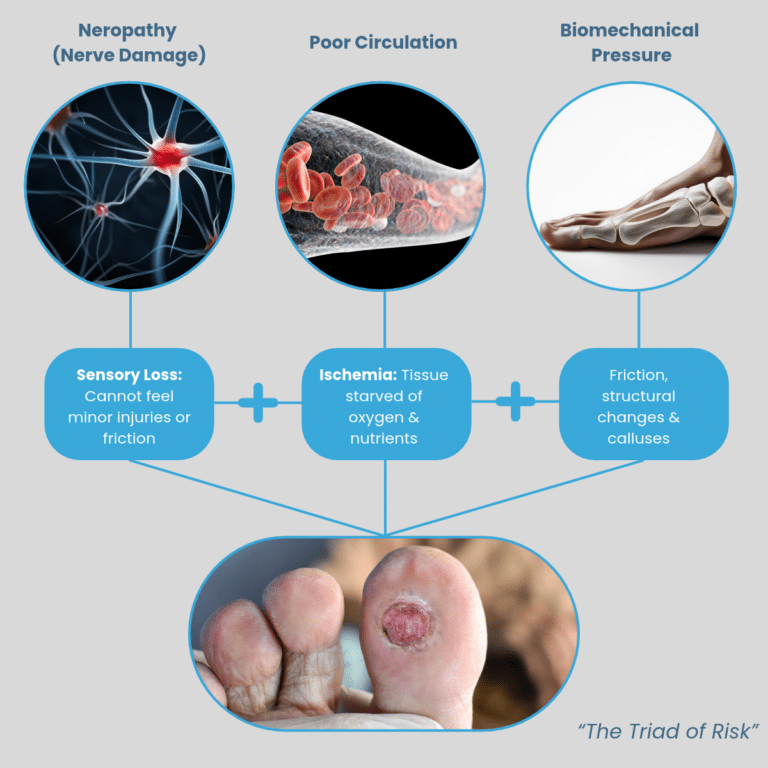
A. Diabetic Peripheral Neuropathy (Sensory, Motor, and Autonomic)
Persistent hyperglycaemia damages the delicate microvessels supplying your peripheral nerves:
- Sensory Neuropathy: Leads to a gradual, painless loss of “protective sensation.” You may no longer feel the sharp pinch of a pebble in your shoe, the friction of an ill-fitting seam, or the scalding heat of a bath. Without protective pain signals, minor friction goes unnoticed and continues to rub, developing silently into an open wound (ulcer).
- Motor Neuropathy: Weakens the small intrinsic muscles within the foot. This causes toes to retract or “claw,” pulling the protective fatty cushion forward and exposing prominent bony joints beneath the ball of the foot to excessive ground forces.
- Autonomic Neuropathy: Disrupts the sweat and oil glands responsible for natural skin hydration. The skin becomes dry, brittle, and prone to deep fissures (cracks), which can allow bacteria to penetrate beneath the epidermal barrier.
B. Peripheral Arterial Disease (PAD) & Microvascular Impairment
Diabetes accelerates atherosclerosis (narrowing and hardening of the peripheral arteries). Reduced arterial lumen diameter impedes oxygenated, nutrient-rich blood from reaching the extremities. If the skin is nicked or punctured, the tissue lacks the biological resources required to mount a robust inflammatory response and heal efficiently, significantly heightening the risk of secondary bacterial infection and tissue necrosis.
C. Biomechanical Overload & The Callus Precursor
In healthy tissue, hard skin (callus) forms as a protective shield against repetitive friction. In a diabetic foot with sensory loss, thick callus acts like a hard pebble wedged between the skin and the bone. With every stride, this stiff plaque concentrates ground reaction forces directly into the deeper soft tissues, causing subcutaneous bruising and tissue breakdown beneath the surface—a classic precursor to a neuropathic ulcer.
3. What Happens During a Specialist Diabetic Foot Review?
In accordance with NICE Guidelines (NG19: Diabetic Foot Problems: Prevention and Management), every person diagnosed with diabetes requires a comprehensive, structured foot assessment at least once every 12 months.
At Pod Marlow, our assessments go far beyond a visual glance. Led by our clinical specialists, each evaluation provides an in-depth diagnostic profile of your neurological, vascular, and biomechanical status:
-
Neurological Mapping: 10g monofilament sensory testing and 128Hz tuning fork vibration perception to detect peripheral neuropathy early.
-
Vascular Assessment: Handheld acoustic Doppler ultrasound evaluation of dorsalis pedis and posterior tibial arterial pulses.
-
Dermatological & Structural Screening: Callus pressure mapping, skin integrity analysis, and footwear evaluation.
-
NICE Risk Stratification: Formal risk categorization (Low, Moderate, High, or Active Ulceration) with tailored clinical management plans for patients across Marlow and Buckinghamshire.

4. Specialist Clinical Leadership: Charlotte Poole’s NHS Heritage
Expertise in high-risk foot management requires both diagnostic precision and genuine empathy. At Pod Marlow, our diabetic and at-risk foot care is spearheaded by Charlotte Poole, whose career spans more than two decades at the forefront of diabetic foot health.
Over Two Decades of High-Risk Clinical Excellence
- NHS Foundation & High-Risk Focus: After qualifying from the University of Northampton in 2001, Charlotte established her career within NHS multidisciplinary teams in Reading, managing complex diabetic foot ulcerations, acute charcot neuroarthropathy, and advanced peripheral arterial disease.
- Berkshire NHS Trust Experience: Charlotte continued her specialist practice within Berkshire NHS Trust’s, refining complex vascular and neurological care protocols and working closely with consultant diabetologists and vascular surgeons.
- Educating the Next Generation: Passionate about prevention, Charlotte completed clinical educator training at Southampton University, running structured education programmes for practice nurses and mentoring undergraduate podiatry students. She was also proud to contribute to specialist community diabetes education groups.
A Calm, Compassionate Approach at Marlow Bottom

In 2015, Charlotte joined Pod Marlow, initially delivering dedicated home visits to frail and housebound patients across the community. In 2024, she established Pod Marlow’s modern Marlow Bottom clinic, creating an accessible, welcoming space equipped with cutting-edge diagnostic technology.
“I firmly believe that when you understand your own foot health, you are empowered to manage it safely. Diabetes can feel overwhelming, but structured, routine care transforms anxiety into confidence. My goal is to ensure every patient leaves our clinic feeling understood, thoroughly evaluated, and equipped with a clear, calm plan to protect their mobility.”
— Charlotte Poole, BSc Podiatry, MChS
5. The Golden Rules: Daily Foot Care for Patients with Diabetes
Between clinical reviews, small daily habits provide your strongest defence against complications:
- Perform a Daily 30-Second Foot Inspection: Check the tops, soles, and spaces between your toes under good lighting. Look for redness, swelling, blisters, cuts, or peeling. If bending is difficult, place a mirror on the floor or ask a partner or family member to look.
- Never Walk Barefoot: Even indoors on carpet, wear supportive, hard-soled slippers. A dropped sewing pin, pet claw scratch, or splinter can penetrate numb skin without any warning pain.
- Check Footwear Before Putting It On: Run your hand inside your shoes every morning to feel for loose grit, curled insoles, or worn lining seams that could cause friction.
- Hydrate Skin Wisely: Apply a medical-grade 10%–25% urea cream to the heels and dry soles daily to maintain skin suppleness. Crucial rule: Never apply cream between your toes, as trapped moisture encourages fungal infection and tissue breakdown (maceration).
- Avoid Direct Heat Sources: Never warm cold feet directly on a hot radiator, hot water bottle, or open fire. Reduced temperature sensitivity makes severe contact burns a common winter risk.
- Leave Corns and Calluses to the Professionals: Never use over-the-counter medicated corn plasters, scalpel blades, or chemical callus-removal pads. The salicylic acid in commercial plasters cannot distinguish between healthy and dead tissue and can chemically burn straight through diabetic skin.
6. Red Flag Warning Signs: When to Seek Immediate Help
If you live with diabetes and notice any of the following symptoms, do not wait for your routine check-up. Contact our clinic or your GP/NHS foot team promptly:
- A break in the skin, cut, blister, or unhealed graze that shows no improvement after 24–48 hours.
- Localised swelling, warmth, or spreading redness around a toe or joint.
- Any discharge, clear fluid, or blood leaking through a sock or onto a dressing.
- A sudden change in foot colour (becoming dull white, blue, or dark purple).
- A new, persistent throbbing ache or unusual pain, or a sudden onset of total numbness.

Frequently Asked Questions (Diabetic Foot Health)
How often should a person with diabetes see a podiatrist?
In accordance with NICE clinical guidelines, everyone with diabetes should undergo a structured foot assessment at least once every 12 months. If you have moderate or high-risk factors, such as existing peripheral neuropathy, poor circulation, previous ulcers, or heavy callus formation, clinical reviews are recommended every 3 to 6 months to safely maintain skin and nail integrity.
Why shouldn’t people with diabetes use over-the-counter corn plasters?
Commercial corn plasters contain concentrated salicylic acid. In a person with reduced sensation or sluggish circulation, this acid cannot differentiate between dead skin and living tissue, rapidly burning through the dermis and creating an acute open wound or chemical ulcer. Corns must always be safely debrided by an HCPC-registered podiatrist.
What is the difference between a routine chiropody check and a diabetic foot assessment?
While a routine chiropody appointment focuses on general nail trimming and hard skin removal, a diabetic foot assessment incorporates clinical diagnostic screening. This includes 10g monofilament sensory mapping, Doppler ultrasound vascular checks, temperature and pulse testing, footwear pressure assessment, and formal NICE risk categorisation.
Book Your Comprehensive Diabetic Foot Review
Whether you were diagnosed recently or have lived with diabetes for many years, a thorough clinical evaluation ensures your feet remain safe, resilient, and pain-free.
How to Arrange Your Assessment:
- Book Online 24/7: Click Here to Book Your Diabetic Foot Review
- Telephone Reception: 01628 477377
Visit Charlotte at Our Marlow Bottom Clinic:
- Marlow Bottom Clinic: 52 Marlow Bottom, Marlow, SL7 3NB
(Features modern clinical facilities and free, dedicated off-street parking directly outside for effortless, level access)
Unable to travel into the clinic?
Our trusted Home Visit Service brings Charlotte’s full clinical toolkit and compassionate care directly to your living room.
Please call reception on 01628 477377 to arrange a visit.